Panty Cuts 101
When considering panties for everyday wear, understanding the various cuts available and how they impact fit is important.
Before we dive into specifics, it's important to point out that there are so many variations in women's panties, they cannot be neatly categorized. The lines between categories blur rather significantly, and features from one category often show up in another seemingly at random, with each brand coming up with its own variation of a name for the style. I know that sounds vague and confusing. Welcome to the wonderful world of panties! If, in what follows, you get lost, don't worry. You probably understand it just fine. The reality is simply confusing here.
In order to define the various categories, we need to establish some terminology for the parts of a panty.
To begin with, we have the waistband. Hopefully this doesn't need a lot of exposition, but briefly, it is the topmost portion of the panty that wraps around the body and holds it up. Waistbands can vary in thickness, elasticity, angle, materials, and several other factors. But in every case, it does the job of supporting what happens below.
Strongly related to the waistband is the rise. This describes how far up the body the waistband sits. The natural waist on your body is where you bend when performing stirring renditions of "I'm a Little Teapot." For many people that’s near the navel, but for others (like me) it’s closer to the bottom of the rib cage. The hips are the widest spot on your hip bones (on men, the hips are generally less distinct than on women). The rise of a pair of panties varies from "low-rise," where the waistband sits right on the hips or just barely above, to "high-rise," which can go all the way up to or just above the navel, covering the lower abdomen. There are even more extreme variations from ultra-low-rise (landing below the hip bones) to ultra-high-rise (approaching the natural waist), but these extremes are less common.
Below the waistband arguably the two most important parts are the front panel and back panel. While we can't really say much of anything is universally consistent, it is fair to say that you can generally expect a functional front panel in almost every style (outside of totally impractical lingerie). The back panel, however, comes in all kinds of shapes and sizes. Usually this is discussed in terms of coverage. Coverage varies from "full" (a complete back panel that covers the buttocks completely) to "minimum" or "no coverage" (a g-string or an open back). The degree of coverage is also talked about in terms of how "cheeky" a cut is. The more cheeky it is, the lower the coverage. "Cheeky" is more of a marketing term, however, so it is less standardized. What one brand calls "cheeky," another may consider standard.
Next up, we have the side panels. These connect the material of the front to that of the back around the sides. Side panels can vary between the extremes of being a full leg to not existing at all. They play a big role in how the panties grip your sides and hips as you wear them. Side panels give the garment structure and definition that works with your body rather than relying exclusively on your shape to keep things in place.
Between the front and back panels, between the legs, is the gusset. The gusset is very important for the male body. Women can often get away with a narrow gusset. It may sacrifice some comfort, but it's doable if the desire is there to wear that particular pair. For male anatomy, however, the gusset is the thing that supports and keeps everything where it needs to be. As a general rule, men need a wider gusset, or at least one that can stretch laterally.
The last component I'll mention here is the leg opening. In one sense, the leg opening is where the panties are not. But how they are cut and finished is significant. This includes variation in the shape of the opening, the elastic (or lack thereof), whether the materials are consistent with the rest or contrasting, etc. This area is also a common place for trim such as lace in some designs.
Of course, I'm sure people in the industry could point out all the additional details I missed here, but these are the big ones that impact my evaluation of how a pair of panties will fit me.
Since I cannot be exhaustive in a discussion of the various categories (or "cuts"), I'll simply point out some of the common ones and attempt to provide a good foundational understanding of the variations, which can then serve as a starting point for your own research.

Briefs (image: Amazon)
- Briefs - Full-coverage panties that are typically characterized by a higher rise, larger side panels, rounded leg openings, and generally more fabric overall.

Boyshorts (image: Hanes)
- Boyshorts - Full-coverage panties with side panels that form a complete leg and leg openings which are cut straight across, often right at or just below the gusset. This means there is little or no curvature to the leg opening, and the hemline tends to sit lower on the thigh. These are often mid to high rise, though there can be a lot of variation.

Bikini (image: Simone Pérèle)
- Bikini - The well known cut often associated with swimwear. In underwear form, the cut is very similar. Bikinis have leg openings which are angled upward, leading to smaller side panels. Typically they are still full coverage in the rear, but the leg openings can be quite high-cut. The famous "string bikini" has no side panels at all, with a waistband connecting front to back via narrow strips (sometimes literal strings). Rise tends to vary on the low end, though when it rises higher, the leg cut typically does too, maintaining the characteristic small side panel.

Hipster (image: One Hanes Place)
- Hipster (or Hip Hugger) - Similar to a bikini, these tend to be full coverage and low to mid rise. However, they usually have wider side panels, a wider waistband, and a less dramatically angled leg cut. These are often considered a "comfort" style, balancing coverage, stability on the hips, and flexibility.

Cheeky (image: Tommy John)
- Cheeky - In addition to being a descriptive term for coverage, it also refers to a cut with reduced rear coverage. Cheeky panties often have wider side panels than bikinis, but the cut of the rear of the leg opening more closely mirrors the front, revealing more skin in the back.

Thong (image: AnaOno)
- Thong - Essentially an extreme cheeky. The back panel is reduced to a narrow strip connecting a triangular gusset to the waistband. The side panels are typically minimal or taper to nothing toward the back. The waistband can vary from being a wide, comfortable band to little more than a string.
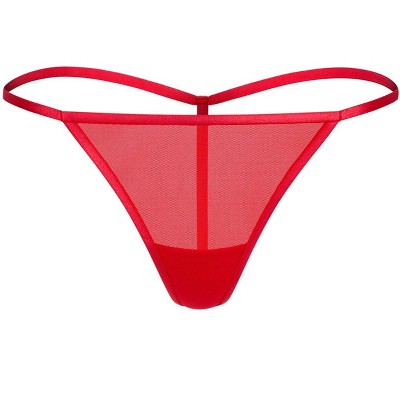
G-string (image: Target)
- G-string - The extreme limit of a thong. A small triangle of fabric in front is connected by narrow straps around the waist and up the back from the gusset to the waistband.
As I mentioned, there are many variations on these as well as numerous other less common cuts. In future posts, we will look at how these cuts affect fit, explore individual pairs of panties to understand their design, and discuss what works best for me.
Until next time... stay comfy!
Published on by Chief Pantyist